04 March 2026
Share


The old folk song opens with an image of rural Filipino life: a hut made of nipa leaves and bamboo, however unassuming, is abundant with garden vegetables. The lyrics flow with a waltz-like structure, three beats per measure, moderate and cheerful. When Jordy Navarra — head chef and owner of One-MICHELIN-Starred Toyo Eatery — reimagined Filipino food culture, he thought of the small yet sufficient bahay kubo.

“When I was working overseas, I noticed how many food cultures represented terroir — the natural topography of a place — through vegetables,” recounts Navarra. “So that was the base thought: if we were to create a Filipino vegetable representation, what would be the best way to go about it? That’s when I remembered Bahay Kubo's lyrics.”
“I wanted to be culturally relevant, celebrate local ingredients and do all of that in a fun, new way.”
“I didn’t want to just tweak adobo,” Navarra says, smiling. “I wanted something more culturally rooted. When I first opened a restaurant and told people I wanted to celebrate Filipino food, the follow-up was always, ‘So it’s adobo with a twist?’ But it’s more than just putting tweaks on familiar dishes."
A harmony of flavors
From root to vine and pod to greens — how do eighteen flavors become one seamless dish?
“That’s the fun part,” Navarra grins.
As a chef, the challenge was not only technical but intentional. “We get to work technically, but with meaning,” he adds. “We’re not just applying cooking techniques randomly; we’re drawing from different practices and principles to make everything whole.”
© Toyo Eatery
Like a maestro conducting an orchestra, Navarra and his kitchen team got to work. They tasted each vegetable, cooking them in various ways to understand how they behaved alone and together. Some vegetables, like onion and garlic, were obvious anchors. Forming the base of so many Filipino dishes, these staple seasonings were best sautéed.
But some vegetables required tuning. Patola, or sponge gourd, started off-key.
“That’s how we ended up with the pickle pile,” he laughs. “We pickled the vegetables that had flavor profiles that would clash with the others. With pickled patola, you get a more complex sour rather than something totally out of harmony with everything else.”
Squash was a standout for Navarra. Its bright orange flesh carries a natural sweetness that Filipinos love to pair with gata or coconut milk. But in the Bahay Kubo symphony, squash was assigned a nuttier note. “We burned a whole kalabasa and sliced it in half,” he explains. “That way, the inside becomes extra nutty instead of sweet.”
From seed to sprout
Translating tradition and transforming taste took time. The idea began brewing in 2010, but the dish did not appear on the menu until 2014. Whether it was the challenge of gathering all 18 vegetables or simply finding the right moment to execute the concept, Bahay Kubo germinated quietly in the background.
Beyond the trial-and-error, the constant mixing and matching of flavors and techniques, Navarra realized that portioning and presentation also played a big part in every bite. “The first iteration of Bahay Kubo didn’t look like what it looks like now,” he recalls. “It was different components put together, like a salad. After a few months, we realized maybe it would look nicer if it were simpler.”
He returned to the image of the nipa hut framed by its edible garden. What if the garden itself could be served in a bowl?
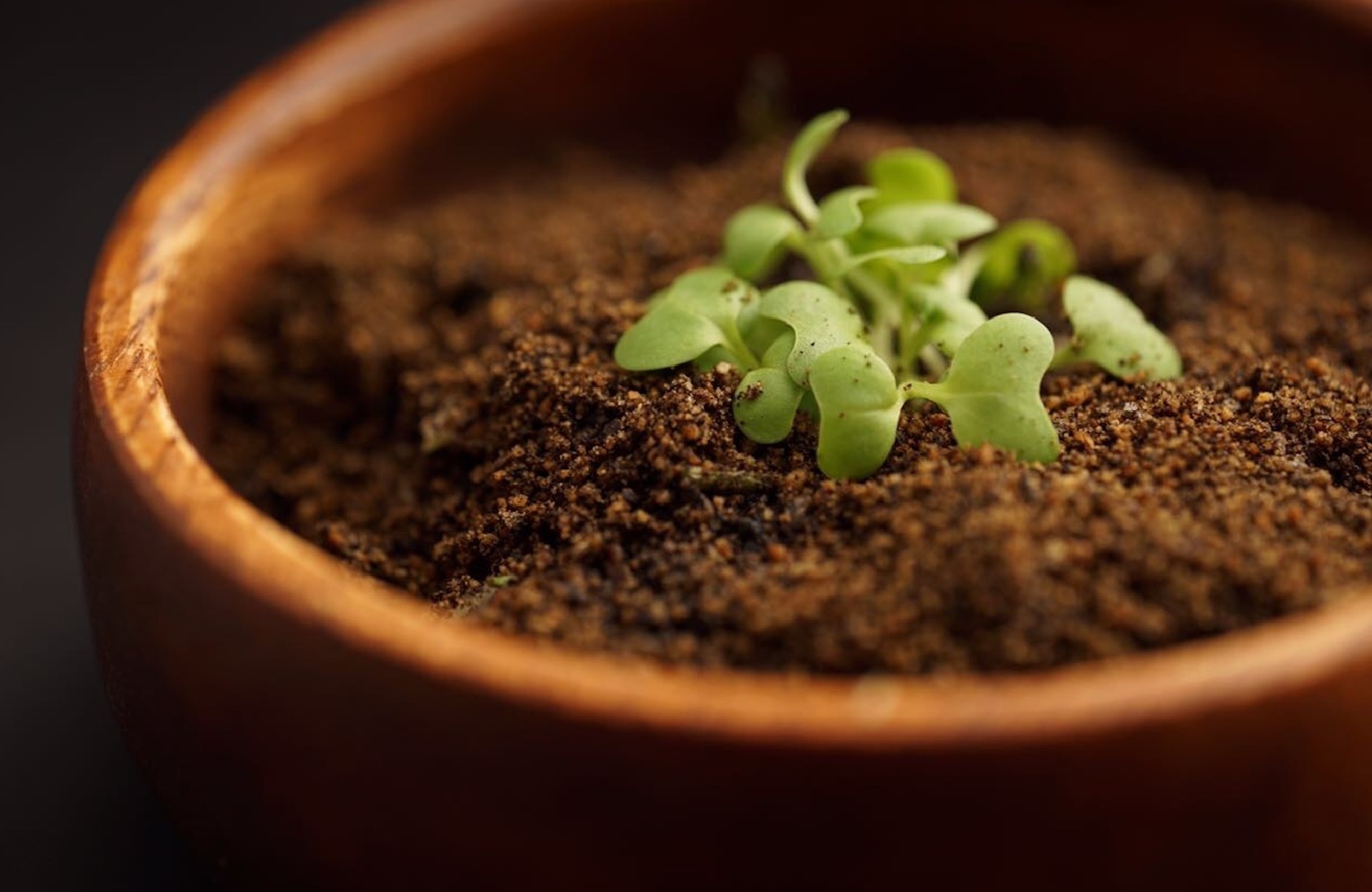
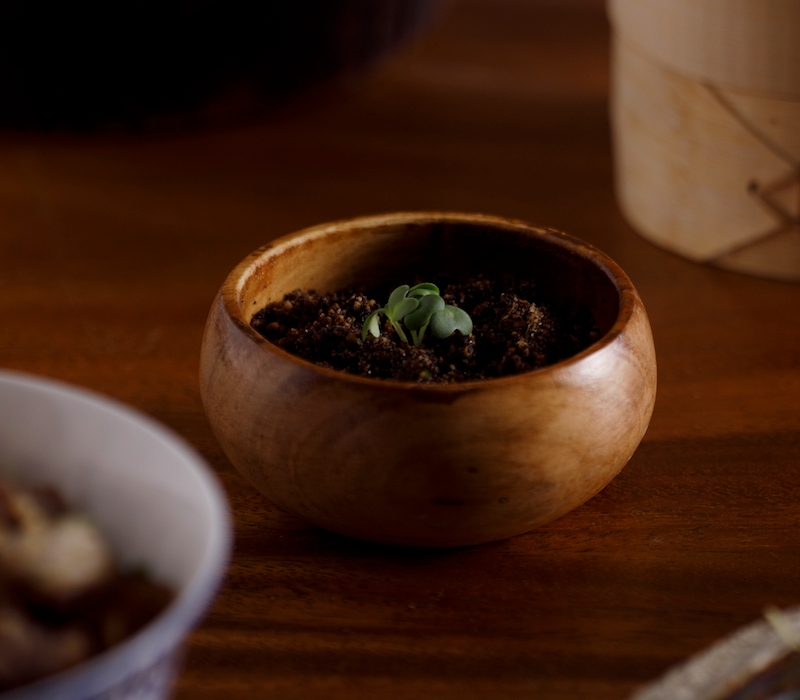
Today, the Bahay Kubo at Toyo Eatery arrives in a small wooden bowl filled to the brim with “soil.” From its center, a single sprout rises, capturing the moment between seed and harvest, the promise of abundance just beneath the surface.
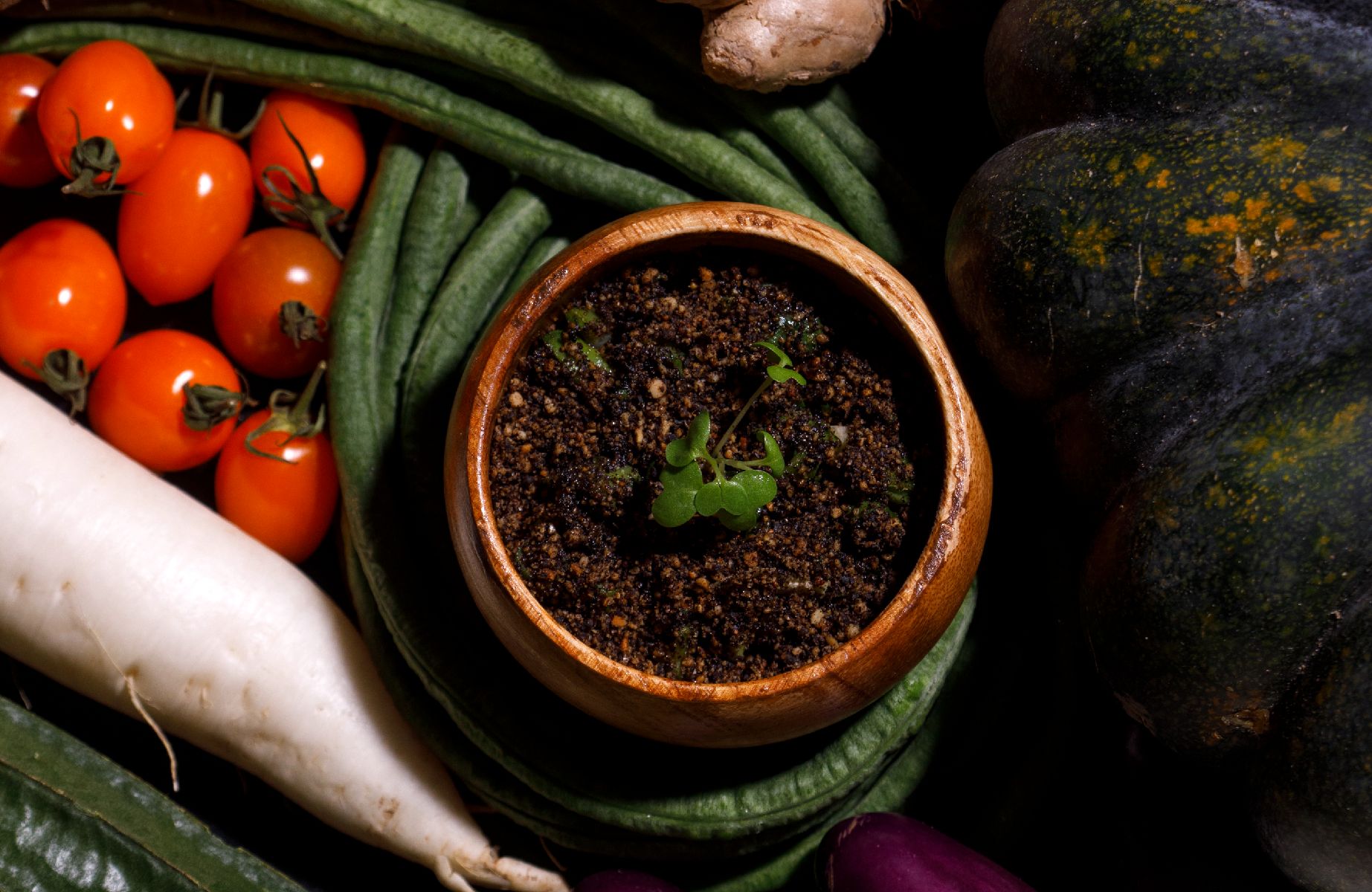
At first glance, the crumbly brown “soil” hardly resembles eggplant. Talong (eggplant) has a smokiness that you tease out by burning, such as in the cooking of torta (omelet). After charring the eggplants, Navarra blends them into a purée, dehydrates the mixture, then grinds it again with roasted peanuts to create an earth-dark powder that will become the Bahay Kubo’s edible soil.
“As for the sprout, it changes,” says Navarra, “Sometimes, it’s mustasa (mustard). Sometimes, it’s radish.”
In sync with the seasonality of local produce, Navarra works closely with farmers and vegetable delivery services such as the Good Food Community to bridge inevitable gaps in supply. Patani (lima beans), for instance, are not available year-round. When harvests are abundant, surplus patani are dried and stored for later use. Navarra’s kitchen adjusts the recipe depending on when the ingredients are fresh, dried or pickled.
For Navarra, the dish relies on basic cooking principles and creative techniques like dehydration, rehydration and pickling. Each of the 18 vegetables must be present, taste and texture layered into every bowl of Bahay Kubo. To serve fewer would be to miss the point.
What makes food local?
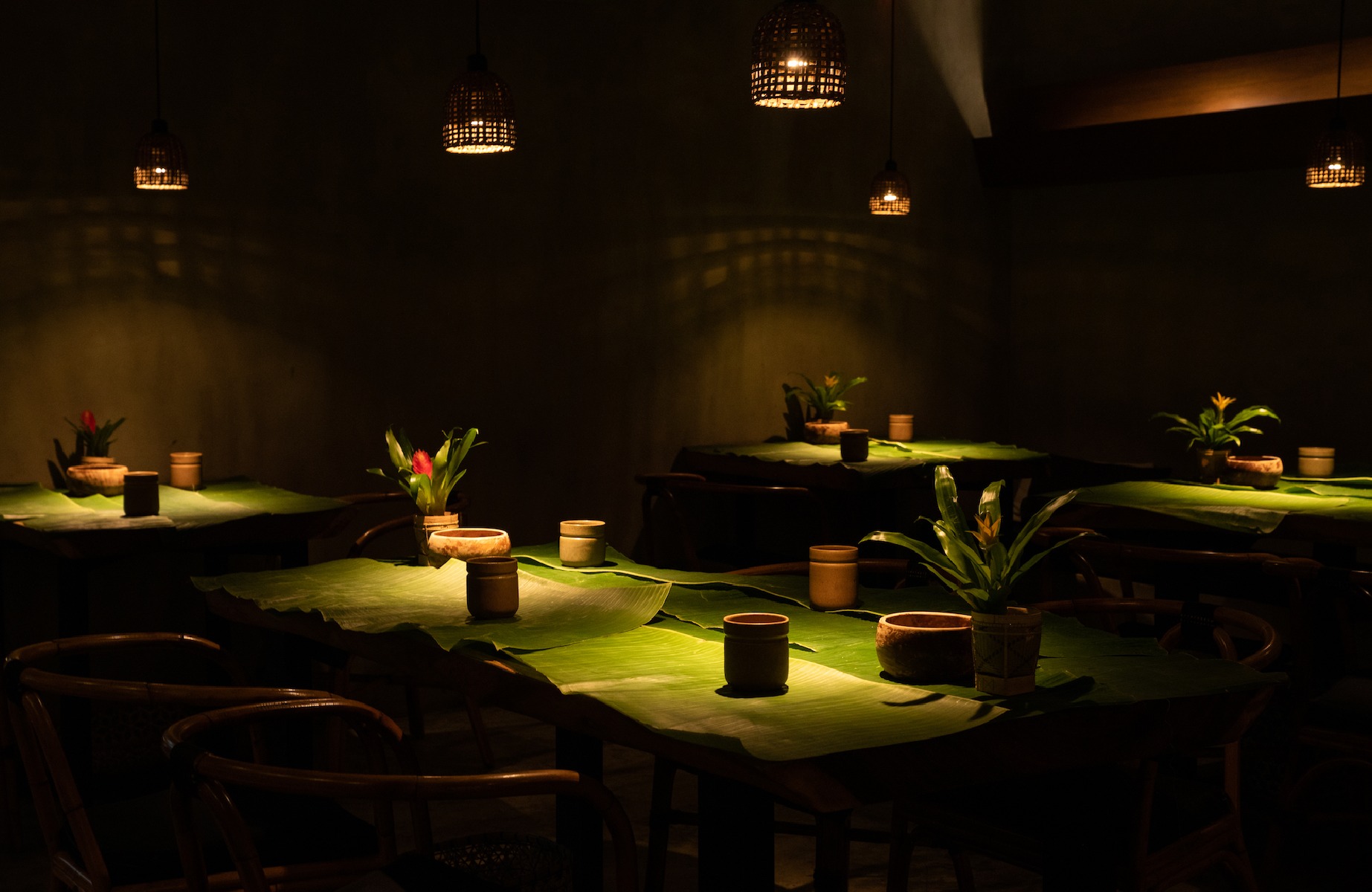
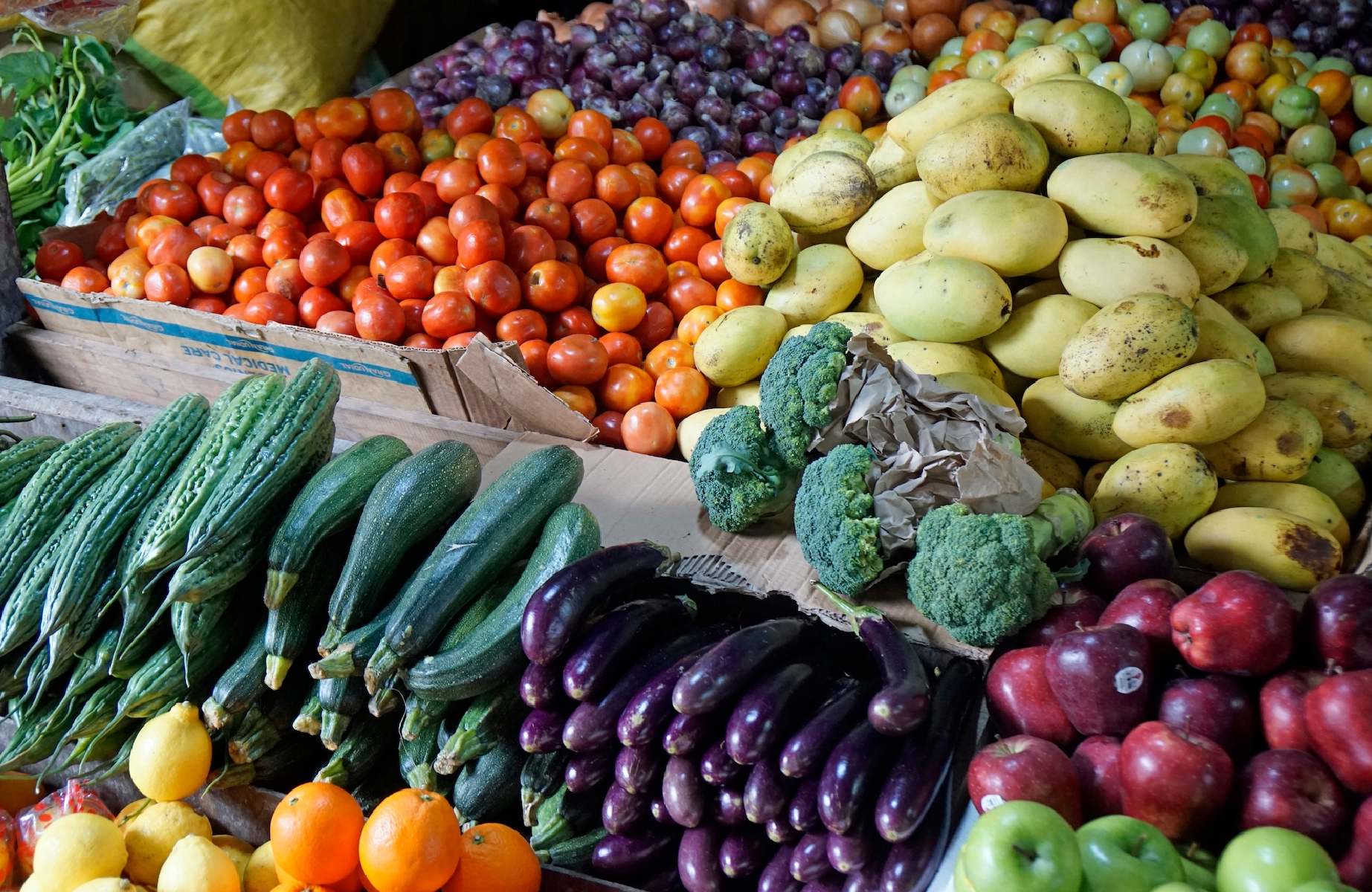
Not all of the vegetables named in the folk song are endemic to the Philippines. Tomatoes trace their roots to South America. Legumes like sigarilyas (winged beans) and sitaw (string beans) have origins in Asia and Africa. Bahay Kubo, however, is a cultural representation of the Filipino garden: rich and nutty, smoky and sour, seasonal yet easy to grow. The song is all about self-sufficiency and sustenance.
“Does it have to exist only in the Philippines?” Navarra asks, challenging the rigid notion of what makes food local.
“Yes, we all want to work with local ingredients and local producers. But there’s a side to culture that doesn’t necessarily mean it has to come from here.”
He points to pandesal, the bread of salt, a centerpiece of every Filipino breakfast table. “If you analyze pandesal by ingredient, you’ll learn that Filipinos don’t have a history of growing wheat. Wheat does not thrive in our tropical climate, yet no morning or merienda is made without pandesal and palaman (bread spread).
“Even the name toyo (soy sauce) comes from a product we don’t traditionally manufacture.”
Locality, then, is not about exclusion or exclusivity. Food cultures grow from what they cultivate and from what they adopt from other terroirs. To define “local” by origin alone would reduce the richness of history and taste, flattening flavor profiles.
“Even if we raised calves here,” Navarra adds, “Filipino food culture does not use veal.”
For Navarra, local means widespread relevance. If an ingredient, regardless of its origin, has found its way into a culture’s kitchen, garden and rituals, then it belongs.
What does Bahay Kubo taste like?
First, stir the “soil” to fold all of the flavors into every spoonful. Diners can sample everything at once, or roll the mixture with hoti seaweed, the same delicate wrapper used in fresh lumpia (spring rolls) and eat it by hand.
“Aside from the harmony of flavors, you’ll notice the changes in texture, so it’s not boring.” Navarra describes each bite of Bahay Kubo as having hints of pickled acidity, moments of nuttiness and smokiness and layers of sweetness, bursting with the soft crunch of candied kundol (winter melon).
“If the dish were a song, its bass line would consist of squash, eggplant, peanuts and beans.”
Today, Toyo Eatery serves the Bahay Kubo with a broth made from all of the vegetables harvested by their partner farmers. The composition changes with every harvest. Adding the broth is their way of updating the idea of celebrating local vegetables, more than a decade after the original dish was released.
“The cool part about local food is that a lot of what we have, we don’t know about yet,” Navarra reflects, recalling the first time he encountered asin tibuok, or salt made by soaking coconut husks in seawater, a tradition preserved in parts of Bohol, Guimaras and Panay.
“But we are optimistic; we lean toward possibilities. We focus on providing for communities, on being responsible and vigilant in recognizing and protecting these traditions.”
For Navarra, Bahay Kubo is less about a list of vegetables than a way of looking at the world: to be inspired and sustained by what surrounds you.
Through Toyo Eatery, that garden has expanded. Navarra has since connected with creatives: designers, architects and potters who hand-shaped the ceramics in which their dishes are served. He met musicians and filmmakers, farmers, fishermen and fellow fans of heritage and culture. In the middle of Toyo Eatery's garden is May, Navarra’s wife, whose background in finance anchors the restaurant’s daily rhythm.
For Toyo Eatery's tenth anniversary happening in March 2026, Navarra and his team will celebrate not only local food, but the people who make up their own backyard garden.
“We’re celebrating us by celebrating them,” he smiles.
Because Bahay Kubo, however small, feeds many.
Want to recreate Toyo Eatery’s Bahay Kubo using ingredients you may already have at home? Here's how.
Burnt Kalabaza (Burnt Squash)
Ingredients:
1 squash, quartered, deseeded
2 tbsp coconut cream
Salt to taste
1. Cover squash with foil and place in a pot with the lid on. Pan roast over medium heat for 1.5 to 2 hours or until squash is tender and deeply caramelized.
2. Scrape off the meat from the pot and mash. Whisk in coconut milk and cook for 2-3 minutes (heat). Season with salt.
Singkamas (Turnip)
Ingredients:
1 turnip, aged at room temperature for a few days
1. Peel off turnip skin and trim off hard ends.
2. Slice turnip into thin sheets and then cut into strips. Keep chilled until ready to use.
Sigarilyas and Sitaw Mix (Winged Bean and String Bean Mix)
Ingredients:
Handful of winged beans sliced into 1/2 inch pieces
Handful of string beans, sliced into 1/2 inch pieces
Vegetable stock, cold
1 tbsp coconut oil
1 onion, minced
5 cloves of garlic, minced
1-inch ginger, smashed
Salt and Pepper to taste
1. Bring a pot of salted water to a boil and blanch the winged beans and string beans separately for 8-10 seconds. Place them in a bowl with ice water to stop the cooking process. Afterwards, steep in cold vegetable stock overnight.
2. Prior to plating, heat oil in a pan over high heat and stir fry the onions, garlic, ginger, winged beans and string beans. Remove ginger and season with salt and pepper to taste.
Sesame Dressing
Ingredients:
1/2 cup sesame oil
1/2 cup vinegar
1 tbsp raw washed sugar
Salt to taste
1. Whisk together all the ingredients.
2. Transfer to a squeeze bottle or other container. Set aside.
Pickled Vegetables
Pickling Liquid
Ingredients:
1 cup vinegar
2 tbsp raw washed sugar
2 tsp salt
1. Combine vinegar, sugar and salt in a bowl.
2. Mix until sugar has dissolved. Set aside.
Pickled Mustasa (Mustard Greens)
Ingredients:
A Handful of mustard greens
Pickling Liquid
1. Bring a pot of salted water to a boil and blanch mustard greens for 5 seconds. Transfer to a bowl of ice water and drain once cool.
2. Place the mustard greens in a jar and cover with pickling liquid. Refrigerate and pickle for at least one day before use.
Pickled Patola (Sponge Gourd)
Ingredients:
1 sponge gourd, peeled and diced
Pickling Liquid
1. Place the sponge gourd in a jar and cover with pickling liquid. Place a paper towel on top to evenly pickle the sponge gourd.
2. Refrigerate and pickle for at least one day before use.
Pickled Labanos (Radish)
Ingredients:
1 large radish, peeled, thinly sliced
Salt
Pickling Liquid
1. Rub radish slices with salt for about 5 minutes or until it softens and releases its liquids.
2. Place the rubbed radish in a strainer and under running water to wash off excess salt. Squeeze out water from radish using your hands. Taste to see if the radish is no longer salty.
3. Place the radish in a jar and cover with pickling liquid.
4. Refrigerate and pickle for at least one day before use.
Candied Kundol (Winter Melon)
Ingredients
1 small winter melon, peeled and diced
1tsp tawas (alum powder)
1 1/2 cup white sugar
1 cup water
1. Place the winter melon in a pot. Cover with water and add the alum powder. Boil for 10 minutes. Afterwards, strain the winter melon and place under running water until rinsed thoroughly.
2. In a separate pot, combine the 1 cup of sugar and 1 cup of water and bring to a boil. Reserve the 1/2 cup of sugar for later. Add the rinsed winter melon and boil until tender liquid turns into a thick syrup consistency, and the winter melon is slightly tender.
3. Remove the winter melon and transfer on to a pan with parchment paper. Make sure each piece is spread out to prevent it from sticking to one another. Let cool.
4. Place remaining sugar in a bowl and roll the cooled winter melon pieces.
5. Keep dry and set aside.
Patani (Lima Beans)
Ingredients:
1 cup lima beans
1. Air dry the lima beans in a warm place for 2 days.
2. Rehydrate the lima beans for 10 minutes in water.
3. Bring a pot of salted water to a boil.
4. Add the lima beans and cook for 10 minutes or until tender. Transfer to an ice water bath and drain once cooled.
5. Peel the skin off and store in a container.
Peanut and Eggplant Soil
Ingredients:
5 medium eggplants
3 cups peanuts, pan roasted
Salt and sugar to taste
1. Char eggplants until black over high heat coals and transfer to lower heat to cook fully.
2. Blend charred eggplants into a smooth purée.
3. Spread evenly over a silicone baking mat or drying tray and dry in the dehydrator at 65C for 12 hours.
4. Blend the dried eggplant sheets into a fine powder.
5. Grind the peanuts in a blender into an oily and crumbly consistency. Season with salt and sugar then mix with the charred eggplant powder until it has the color and consistency of soil.
Upo (Bottle Gourd) Chips
Ingredients:
1 bottle gourd
1 cup powdered sugar
1. Cut the bottle gourd in half, lengthwise. Remove seeds and slice thinly, creating crescent slices. Alternatively, you may use a mandolin.
2. Layer the slices of bottle gourd on a tray and dust with powdered sugar until completely covered.
3. Dry in the sun for 1-2 days until brittle.
ASSEMBLY
Ingredients:
Prepared Ingredients
Radish Sprouts
Cherry tomatoes, quartered
1. To assemble, place a dollop of burnt squash at the bottom of your serving plate.
2. Add the candied winter melon, lima beans and cherry tomato slices as the initial layer.
3. Add the pickled vegetables and turnip as the next layer.
4. Add the winged bean and string bean mix. Drizzle on the sesame dressing.
5. Spoon over a thin layer of the peanut and eggplant soil and add some bottle gourd chips.
6. Completely cover with the soil and “plant” the radish sprout in the middle. Serve.
-
Header Image © Toyo Eatery